Speech Cats: Online Speech Therapy Game for Kids
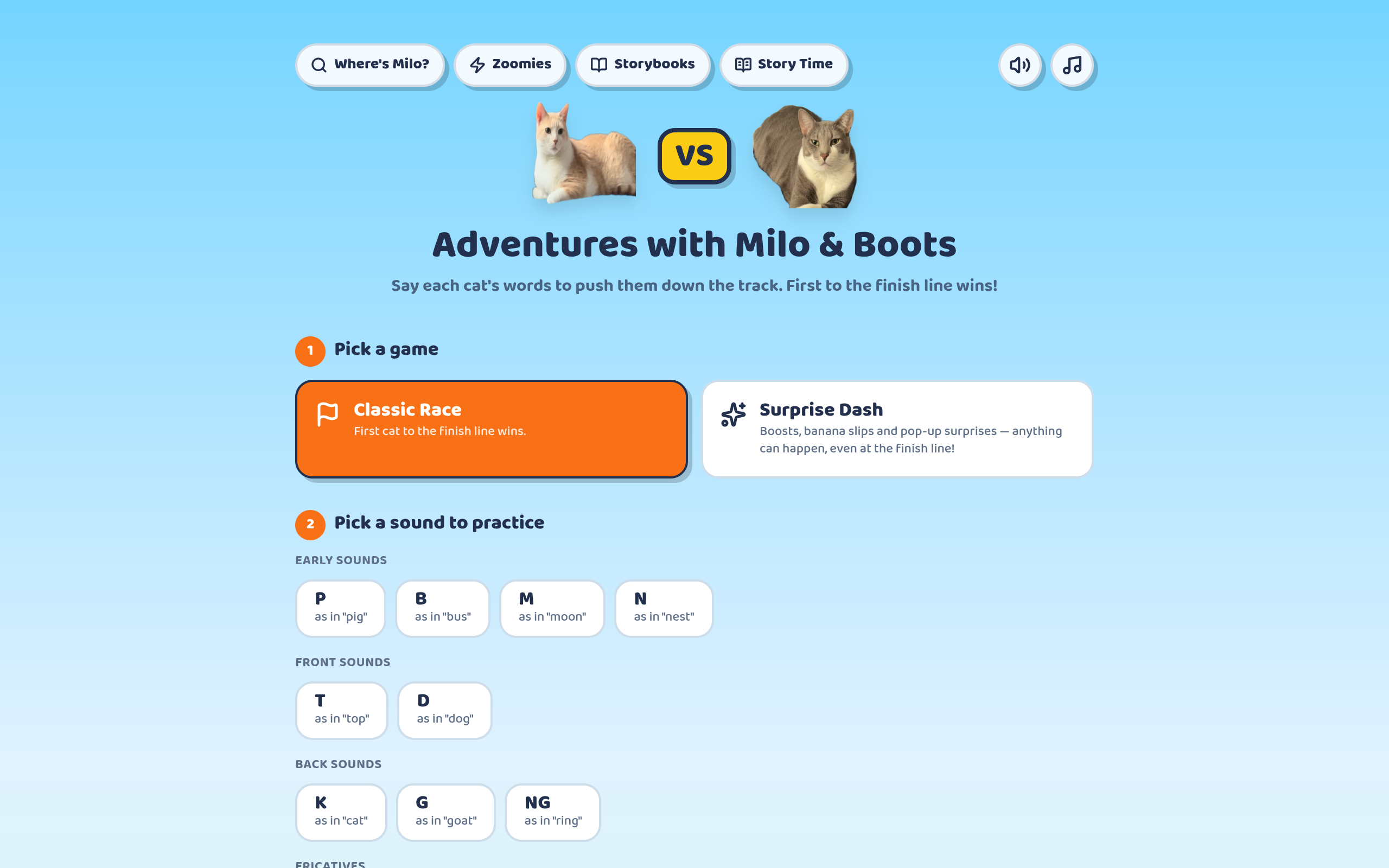
Adventures with Milo and Boots — two cool cats who make speech practice something kids actually ask for.
Included with the Pro plan — create an account to get started
Already have an account? Log inHow to Play Speech Cats
- 1Start an adventure with Milo and Boots — the story is the reason a four-year-old keeps going.
- 2Say each target word out loud as it comes up, clearly enough that the adult nearby can hear the sound.
- 3Keep going. Articulation is motor learning, and the number of correct repetitions is what moves it.
- 4Stop while they still want more — five to ten minutes a day beats one long weekend session.
What Speech Cats Practices
Is Speech Cats Right for Us?
| Ages | Ages 4–10 |
|---|---|
| Where it fits | Anywhere |
| Typical session | 10 min |
| Plan | Pro |
| Format | Speech Therapy Game — runs in any browser, nothing to install |
| Skills targeted | Articulation, Speech Sound Practice, Speech Clarity, Listening |
- Young children working on articulation or phonology goals
- Kids who lose interest halfway through a flashcard deck
- Preschool and early elementary students who need a character to root for
- Home practice between sessions, when a parent needs the practice to run itself
- SLPs who want a no-prep articulation warm-up for a younger caseload
What Is Speech Cats?
Speech Cats is a free online speech practice game starring Milo and Boots, two cats who take kids along on short adventures built around saying words clearly. It was designed by a licensed speech-language pathologist for the age group that gets the least out of straight drill: young children who need hundreds of repetitions but will not sit still for them.
The characters are the whole trick. A four-year-old will not practice a tricky sound because an adult asked nicely, but they will absolutely do it to help a cat. Wrapping articulation targets inside a story keeps kids in the practice long past the point where a flashcard deck would have lost them.
It runs in any browser with nothing to print, laminate, or install — pull it up on a tablet in the waiting room or on a laptop at the kitchen table.
Why Repetition Is the Engine of Articulation Progress
Articulation therapy works through motor learning. A child is teaching their tongue, lips, and jaw a new movement pattern, and like any motor skill — a tennis serve, a piano scale — it takes a great many correct repetitions before the new pattern beats the old habit. Research on therapy dose points consistently in the same direction: more correct productions per session tends to mean faster progress.
That is exactly why engagement matters so much with young children. A session that produces 30 reluctant repetitions is not the same session as one that produces 100 enthusiastic ones, and the difference is rarely the technique — it is whether the child wanted to keep going.
Between sessions is where progress is usually won or lost. Most children see an SLP once or twice a week; what happens on the other five days largely determines how quickly a sound generalizes into everyday speech.
How to Use Speech Cats in Therapy or at Home
In sessions, use it for the high-repetition portion of your block: model the target sound first, then let the game carry the volume of practice while you listen and give feedback on productions. Because it needs no setup, it also doubles as a reward that is still therapy.
At home, five to ten minutes a day beats one long weekend session. Sit close enough to hear how your child is saying the words, and keep feedback light — one clear model of the correct production is worth more than a correction.
If you are not sure which sounds your child should be working on, our free sound library breaks down all 40 English speech sounds — consonants, vowels and diphthongs — by the age each typically develops, and our word lists give you practice words organized by sound and word position.
Included with the Pro plan — create an account to get started
Already have an account? Log inMore Games Like Speech Cats
Matched on the skills this one targets, so the next thing you open keeps working on the same goal.
Frequently Asked Questions
Is Speech Cats free to play?
Who are Milo and Boots?
What ages is Speech Cats for?
Does my child need to read to play?
Ready to Play Speech Cats?
Create an account and upgrade to Pro for unlimited play, progress tracking, and every premium practice activity — pronunciation games, personalized stories, and smart flashcards.
Get Started Free