Speech sounds

Articulation Games for Speech Sound Practice

Articulation is the physical business of producing speech sounds — where the tongue goes, what the lips do, whether the voice is switched on. A child who says "wabbit" for "rabbit" or "tumb" for "thumb" almost always knows the word perfectly well. What they cannot yet do is make their mouth produce it, which makes this a motor problem rather than a knowledge one.

That distinction decides how therapy is run. A new tongue movement has to be produced correctly enough times to beat a habit the child has been rehearsing since they started talking, so clinicians count productions rather than minutes. Fifty correct repetitions inside ten minutes is a good session; ten minutes spent explaining the sound is not, however good the explanation was.Which is the whole reason a game is here at all. The game supplies the thing that is genuinely hard to buy — a child who wants to keep going for another turn — and the word list you pair it with supplies the target. Pick a sound from our sound library, then pick a game below.

Playable in any browser

Compare the articulation games

For articulation the useful columns are Ages and Session. A sound is learned by repetition, so the real question is how many correct productions fit into the ten minutes you actually have — not which game looks most elaborate.

Compare the articulation games
GameWhat it practicesAgesWhere it fitsSessionPlan
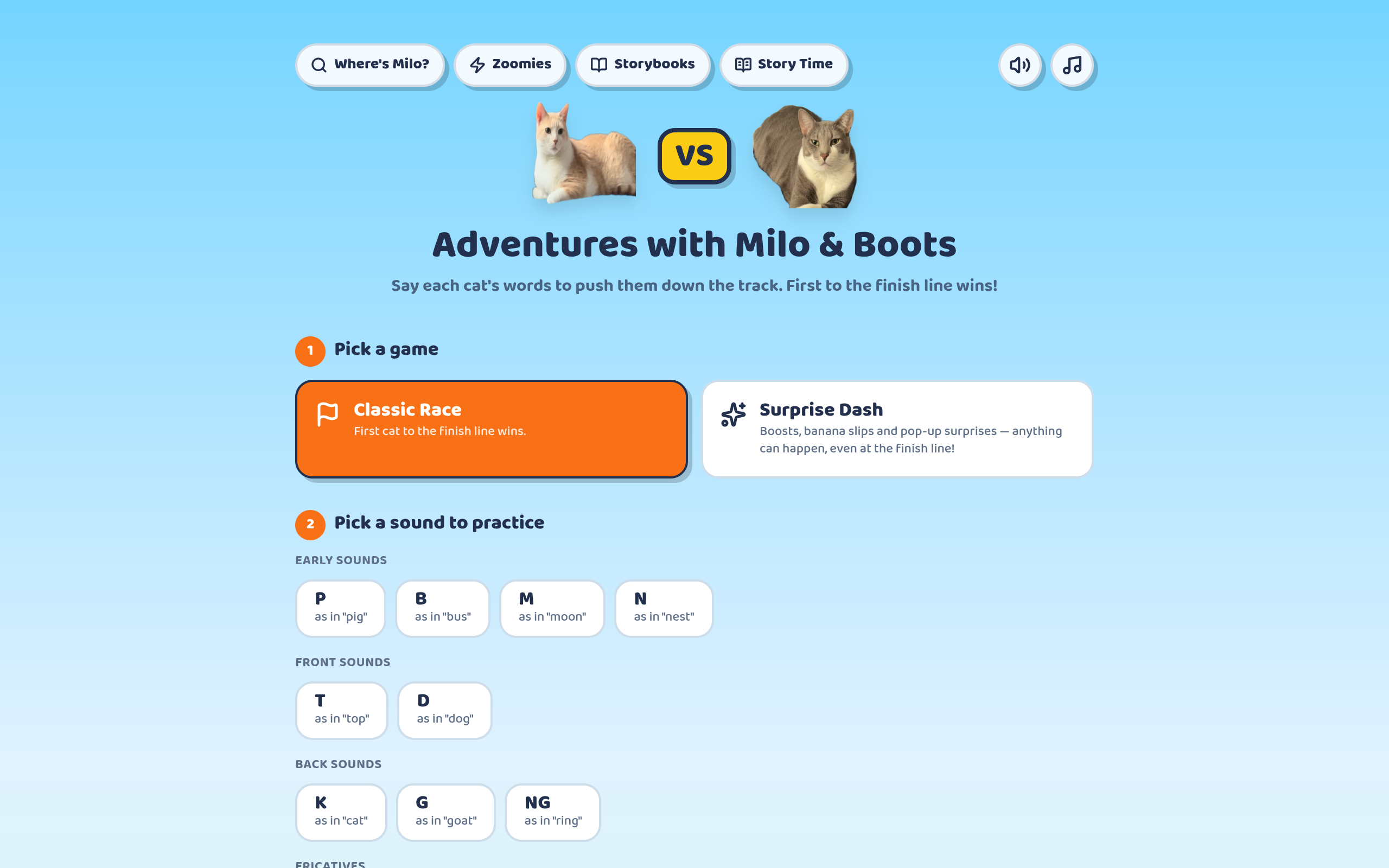
Speech CatsArticulation, Speech Sound Practice, Speech ClarityAges 4–10Anywhere10 minPro

“Session” is a typical sitting, not a level length — none of these games end on their own. A dash means we have not published that detail for a game yet rather than that it does not apply.

Articulation games

Speech Cats is our hand-written articulation game; published catalog activities tagged for speech sound work appear alongside it, so this list grows without a deploy.

1 activity on this page.

How Kids Practice With These Games

  • Repetitions without the fight

    Progress in speech and language runs on volume of practice. A ten-minute game produces dozens of engaged responses where a worksheet produces a handful of reluctant ones — the target is identical, the willingness is not.

  • Built around real therapy goals

    Every game is developed by our team with our clinical lead, a licensed speech-language pathologist, against the targets that appear on IEPs and treatment plans: articulation, vocabulary, comprehension, following directions, and pragmatic language.

  • Nothing to install or print

    They run in any browser, on a phone, tablet, Chromebook, laptop, or classroom smartboard, and they are built touch-first — so the iPad on the sofa and the cart in the school library behave the same way.

  • Practice out loud, not just tapping

    Several games ask the child to say the word or record their answer and play it back. Hearing your own production is the fastest feedback there is, and it is the part a printable can never do.

  • Practice that gets recorded

    An account keeps a history of what was practised across every activity on the site, so "has this actually helped?" has an answer that is not a memory. Trends and sound mastery over time are Pro features.

  • No ads, and no accounts for children

    Games sit behind a login, so they are not in ad networks and not open to the web. A parent, therapist, or teacher holds the account and the data — children never make one themselves.

What Articulation Therapy Actually Targets

Speech sound errors come in four shapes and an SLP will name which one they heard. A substitution swaps one sound for another ("wed" for "red"). A distortion produces the right sound imprecisely — the lateral lisp, where /S/ leaks over the sides of the tongue, is the classic. An omission drops the sound entirely ("boa" for "boat"), and an addition inserts one that does not belong ("buh-lue" for "blue"). Substitutions and omissions in a young child are often part of a broader pattern; distortions in an older child are usually a stubborn motor habit.

Age matters as much as the error. Sounds arrive on a schedule: /P/, /B/, /M/ and /N/ are usually in place by three, /K/, /G/, /F/ and /SH/ follow, and /R/, /S/, /Z/, /L/ and /TH/ are frequently still settling at six, seven or eight. Most children master /R/ by age 6-7, and vocalic R — the R in "bird", "car", "her" — often runs to eight. A five-year-old saying "wabbit" is on an ordinary timetable. A five-year-old whose grandparents cannot follow them is not.

Targets are then worked through a hierarchy: the sound in isolation, then in syllables, then in single words, then phrases, sentences, and finally conversation. Each step is only as useful as the accuracy at the step before it, which is why an SLP who says "we are at word level in the initial position" is giving you a precise instruction rather than jargon.

Why a Game Beats a Card Deck Here

Nothing about a flashcard is wrong. The problem is arithmetic: a child will produce a target word perhaps twenty times before boredom ends the session, and twenty is not many repetitions against a habit years deep. Anything that buys another thirty productions from the same child in the same ten minutes is doing real clinical work, and that is the only claim a game needs to make.

The second thing a game adds is retrieval under mild pressure. Saying a word from a card you are looking at is easier than producing it while also tracking a score, taking a turn, and deciding what to do next — and the harder version is closer to conversation, which is where the sound eventually has to survive.

It is worth being clear about what our arcade-style games do not do. They build articulation and speech clarity broadly rather than drilling one phoneme. Sound-specific targeting lives in the practice tools inside an account, where you choose the sound and the position in the word, and in the free word lists on every sound guide.

Running Articulation Practice at Home

Five to ten minutes most days beats half an hour on a Saturday. Frequency is what converts a taught sound into an automatic one, and short sessions are far more likely to survive a real week than good intentions about a long one.

Ask the school or clinic SLP for the exact current target before you start — not "the R sound" but which R, in which word position, at which level of the hierarchy. Practising initial /R/ while the session is working on vocalic R is well-meant effort spent in the wrong place, and it happens constantly.

Model rather than correct. Constant correction makes children talk less, which is precisely backwards. Say "yes, a rabbit" clearly and carry on; save direct practice for the dedicated few minutes. One clean model is worth three corrections, and the accumulated hearing of the right version does more work than families expect.

What to Expect, and What Not To

/R/ is usually a matter of many months rather than weeks. It requires a tongue position that cannot be seen, cannot easily be felt, and has usually become habitual — which is why it is both the most commonly targeted sound in English and the one families most often expect to move faster than it does.

The last stage is the long one. Getting a correct sound in a word is often quicker than getting it into unmonitored conversation, and carryover is where most of the calendar goes. Practice that happens in ordinary talking — naming things on a walk, reading aloud, a game — matters more at that stage than another set of word cards.

None of this replaces an assessment. A game gives you repetitions; it does not tell you whether the error pattern is developmental, whether hearing has been checked, or whether what you are hearing is a phonological pattern that needs a contrast approach instead. If a child is hard to understand for people outside the family, that is the conversation to have first.

Frequently Asked Questions

What is an articulation game?
A game used to get a large number of correct productions of a target sound in a short sitting. The game supplies the motivation and the repetitions; the target sound comes from the word list you practise alongside it. It is the delivery mechanism for the drill, not a replacement for it.
Do your games target one specific speech sound?
The arcade-style games do not — they build articulation and speech clarity generally. Sound-specific targeting lives in the practice tools inside an account, where you pick the sound and the position in the word, and in the free word lists on each of our 40 sound guides.
Which sound should we work on first?
Usually the earliest-developing sound the child is still getting wrong, because those are both the quickest wins and the most damaging to being understood. If an SLP is involved, work on the target they set — a different sound practised at home is effort spent in the wrong place.
How much articulation practice does a child need?
Think in repetitions, not minutes. Five to ten minutes most days, aimed at as many correct productions as you can get, beats a long weekly session. The best predictor of how fast a sound moves is how many correct productions happen per week.
Can articulation games replace speech therapy?
No. A game adds practice volume between sessions, which is often what sets the pace, but it cannot assess an error pattern, check hearing, or decide whether a contrast approach would work better than drill. If a child is hard for unfamiliar adults to understand, start with an assessment.

Start Practising a Sound

Create a free account and play every articulation game, with the full word bank behind it. No credit card required.

Get Started Free

Start free • No credit card required