For your caseload

Speech Therapy Games for SLPs

You have twenty-five minutes, three students with three different goals, and the last group ran over. Nothing on this page needs printing, cutting, laminating, or a login you have to set up for a child. You open a tab and the activity is running.

The games below carry a typical sitting of five to fifteen minutes each, which is the number that actually decides whether an activity fits a school block. That figure is in the comparison table beside the target skill and the age range, so you can pick on the two things that matter before the group sits down rather than after.One thing worth knowing in minute two rather than week two: the free plan holds a single student profile and has no progress tracking or reports. Every game is free to play, but per-student data across a caseload is a Pro feature. We would rather you read that here than find it while a session is running.

Compare the Games by Target and Session Length

Two columns do most of the work on a caseload: what it practices, so a game maps onto a goal area, and Session, so you know whether it fits the twenty minutes you actually have. Ages narrows it after that. There is no column for whether an activity records audio — each game's own page describes what the student does.

Compare the Games by Target and Session Length
GameWhat it practicesAgesWhere it fitsSessionPlan
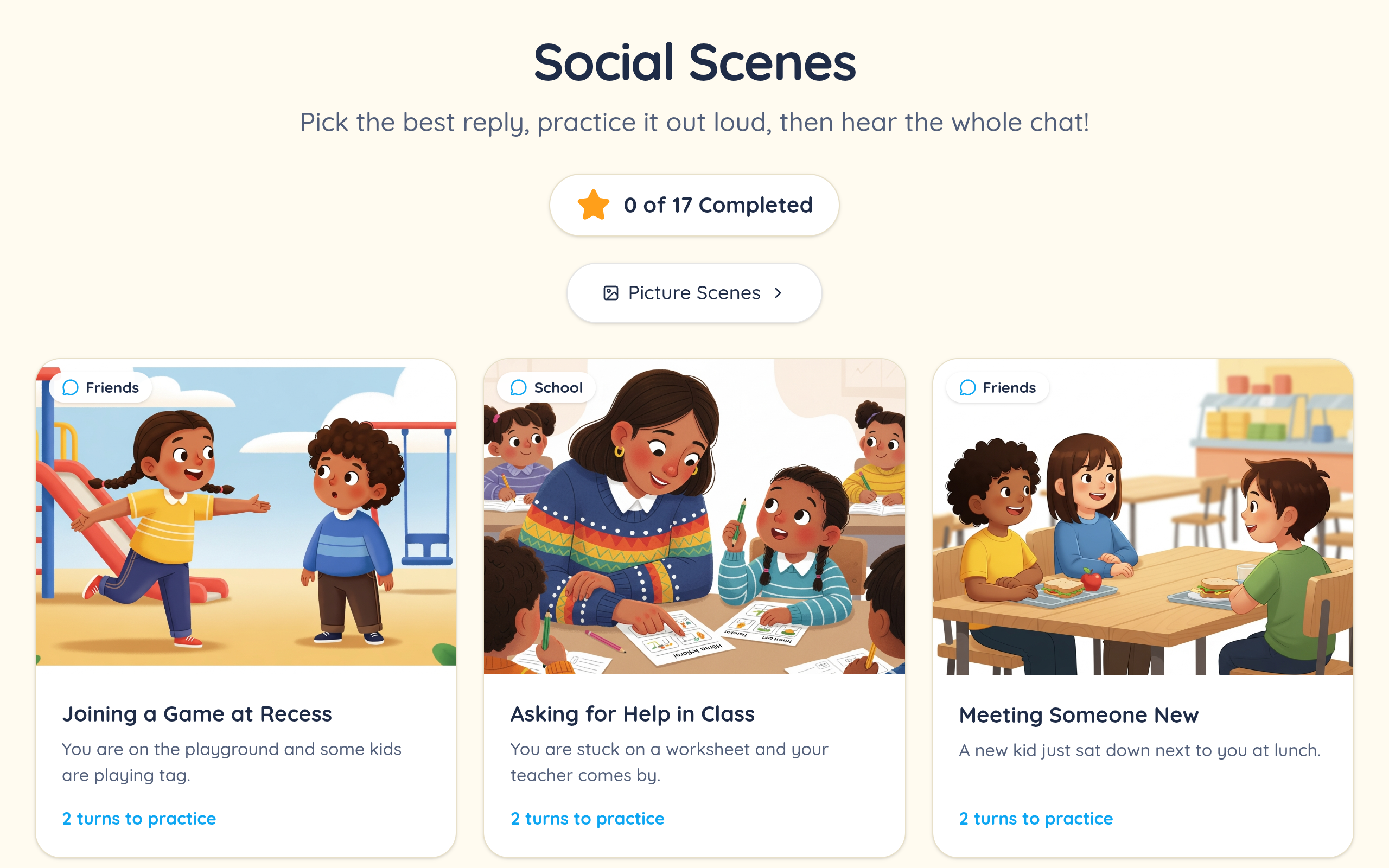
Social ScenesConversation Skills, Social Communication, Self-MonitoringAges 6–13Anywhere15 minPro
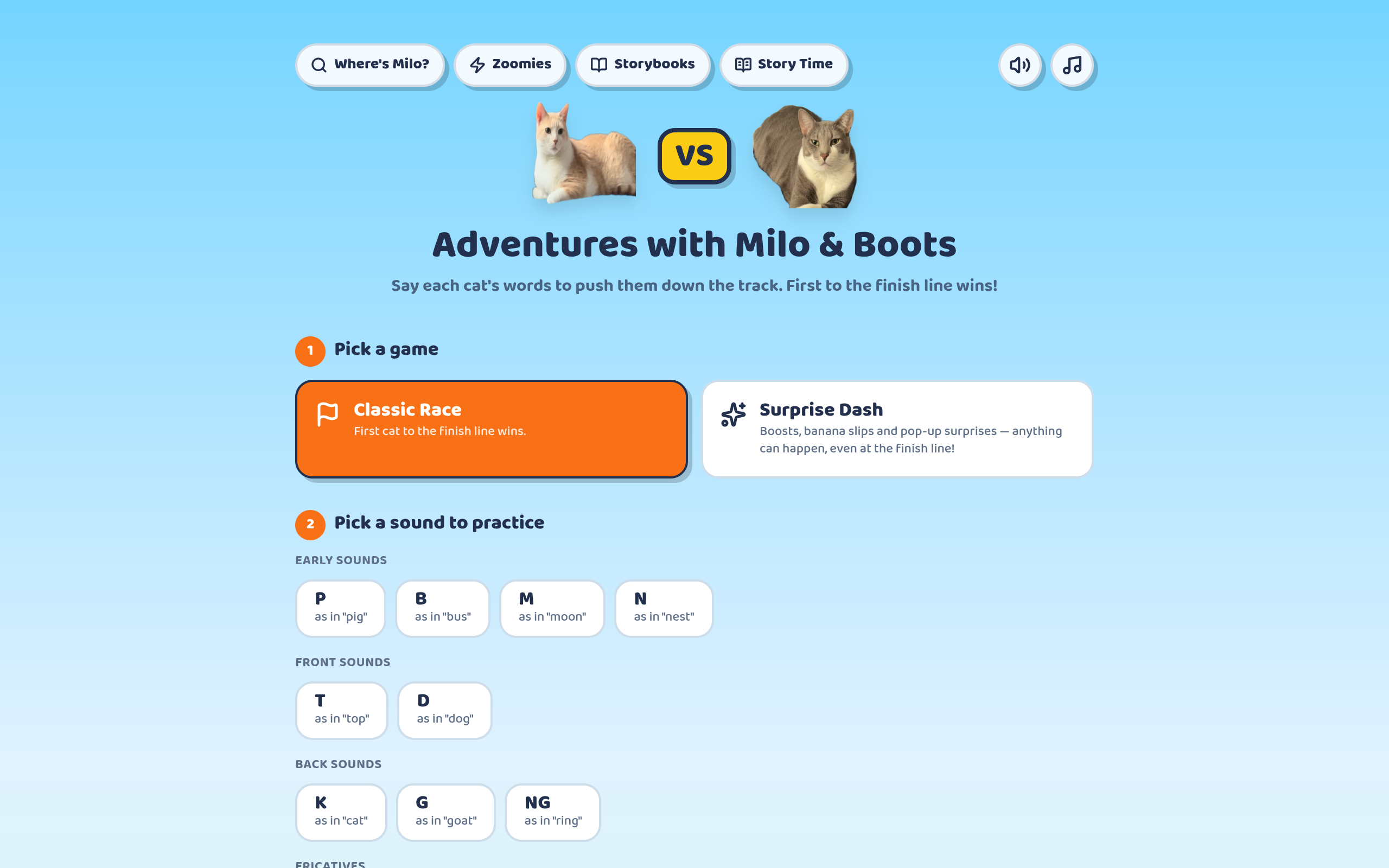
Speech CatsArticulation, Speech Sound Practice, Speech ClarityAges 4–10Anywhere10 minPro
Level UpSynonyms, Antonyms, Multiple MeaningsAges 7–13Anywhere5 minPro
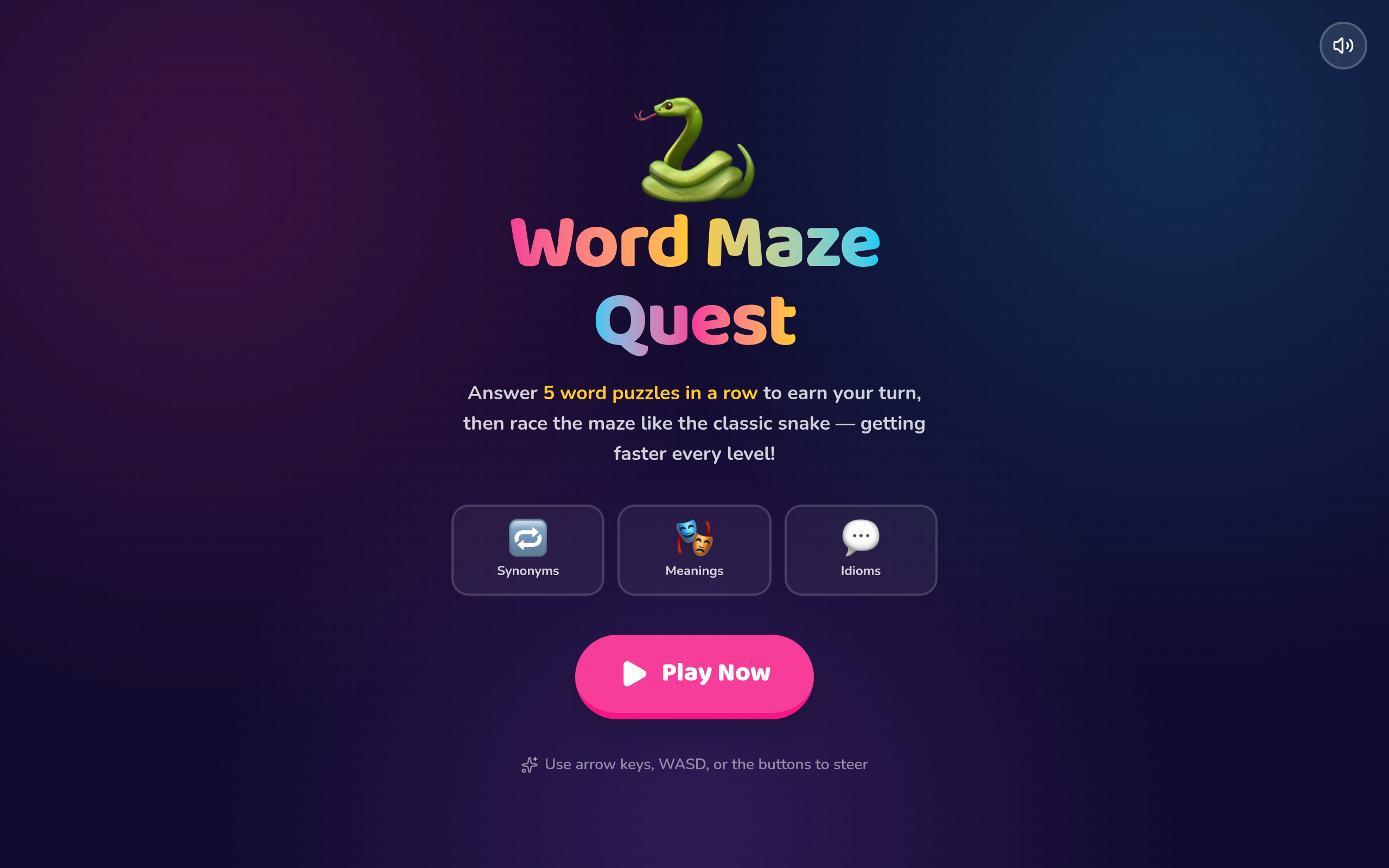
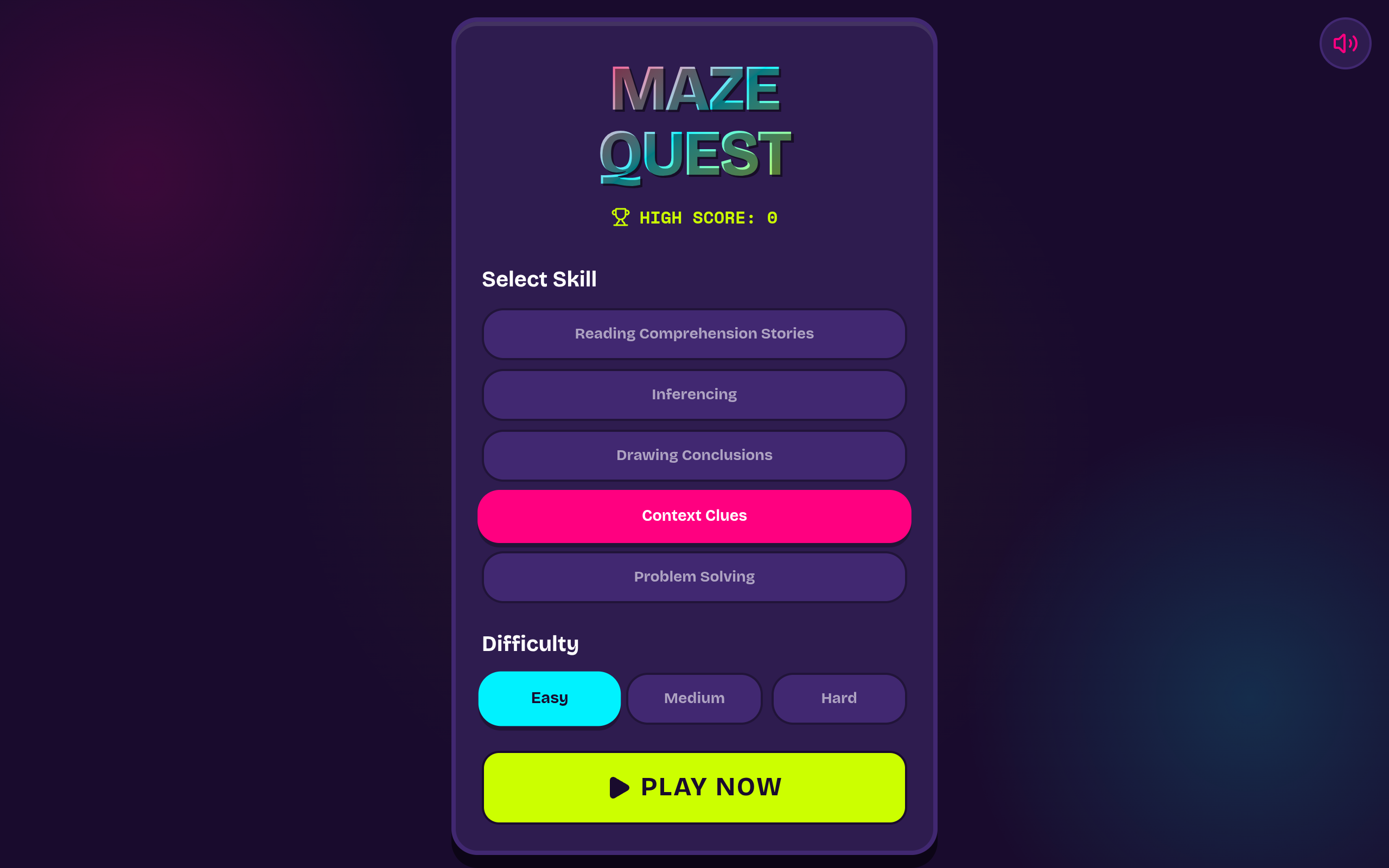
Maze QuestComprehension, Inferencing, ReasoningAges 6–12Anywhere10 minPro
Social SparkSocial Skills, Emotional Regulation, Perspective TakingAges 6–13Anywhere10 minPro

“Session” is a typical sitting, not a level length — none of these games end on their own. A dash means we have not published that detail for a game yet rather than that it does not apply.

How Kids Practice With These Games

  • Repetitions without the fight

    Progress in speech and language runs on volume of practice. A ten-minute game produces dozens of engaged responses where a worksheet produces a handful of reluctant ones — the target is identical, the willingness is not.

  • Built around real therapy goals

    Every game is developed by our team with our clinical lead, a licensed speech-language pathologist, against the targets that appear on IEPs and treatment plans: articulation, vocabulary, comprehension, following directions, and pragmatic language.

  • Nothing to install or print

    They run in any browser, on a phone, tablet, Chromebook, laptop, or classroom smartboard, and they are built touch-first — so the iPad on the sofa and the cart in the school library behave the same way.

  • Practice out loud, not just tapping

    Several games ask the child to say the word or record their answer and play it back. Hearing your own production is the fastest feedback there is, and it is the part a printable can never do.

  • Practice that gets recorded

    An account keeps a history of what was practised across every activity on the site, so "has this actually helped?" has an answer that is not a memory. Trends and sound mastery over time are Pro features.

  • No ads, and no accounts for children

    Games sit behind a login, so they are not in ad networks and not open to the web. A parent, therapist, or teacher holds the account and the data — children never make one themselves.

Running a Mixed Caseload With Minutes Between Groups

School and clinic scheduling produces groups that share a slot rather than a goal. The realistic constraint is not finding a perfect activity for each student — it is finding one that gives everyone in the room something to do while you take data on one of them.

The five-to-fifteen-minute figure in the table above is a typical sitting, not a level length; none of these games end on their own. That is deliberate, and it means you stop when the session stops rather than negotiating with a child about finishing a level. Practically, the shortest activities fit a warm-up or a carryover probe at the end of a block, and the longer ones carry a whole session when a group needs one thing to hold them.

Because nothing is consumed, there is no reason to save a good activity for later. An itinerant clinician working across buildings carries a login rather than a crate, and the material in the third school is identical to the material in the first.

What You Get for Data, and What You Do Not

Straight version first. Progress tracking is a Pro feature, and there is no progress-report export yet. The free plan covers one student profile, one generated story a month, and 100 pronunciation-scoring attempts a month. If you need accuracy trends and session history per student across a caseload, that is Pro: three student profiles, 5,000 pronunciation-scoring attempts a month, and 20 stories.

The second thing to be clear about is what the data is. Pronunciation scoring gives you accuracy at the word and sound level from a recording, which is a practice signal and a useful trend line — it is not a standardized assessment, and it should not appear in an evaluation report as though it were one. Treat it the way you would treat a probe you designed yourself: good evidence of change over time, not a normed score.

For IEP progress reporting, the honest workflow is that the platform gives you the repetitions and the trend, and you still make the clinical judgement about whether the goal criterion was met. Anyone promising you IEP data straight out of a game is selling you something we are not selling.

Matching a Game to a Goal Area

The games target skill areas rather than individual phonemes: articulation and speech clarity, vocabulary and semantic relationships, comprehension and inferencing, social communication and conversation, and feeding and food exploration. That maps reasonably onto how goals are written, which is usually by area and criterion rather than by activity.

What a game will not do is hand you a specific target — initial /r/ at the phrase level, say. For sound-specific and position-specific material, the word bank is the tool: more than 9,200 words across the English speech sounds, filtered by position and difficulty, plus the worksheet generator for the same targets on paper. Use a game for volume and buy-in, and the word lists when the goal names a sound.

The practical pattern most clinicians land on is a game as the vehicle and the target as the content: the student is playing, you are eliciting, and the game is what makes the fortieth repetition acceptable to a nine-year-old.

School Devices, Filters, and Who Holds the Account

Everything runs in a browser with no install and no admin rights, which is usually what decides whether a tool can be used in a district at all. Managed Chromebooks, locked-down laptops, iPads, and interactive displays all handle a browser tab. If your district filters by domain, speechtherapymagic.com needs to be permitted, and that is worth checking before you plan a session around it.

Children never create accounts. The adult holds the account and controls the data, which is generally the first question a district privacy review asks, and it is also why these games are not in ad networks — there is no child-facing signup to monetize.

For anything formal — a site licence, a data protection agreement, a subprocessor list — our schools page covers it. Our for-SLPs page covers the rest of the platform: pronunciation scoring, the story builder, the worksheet generator, and the deck builder.

Frequently Asked Questions

How much prep does one of these games need?
None. There is nothing to print, cut, laminate, or configure — you open a tab and it runs. That is the whole reason a digital activity survives a schedule with ninety seconds between two groups.
How many student profiles do I get?
One on the free plan, three on Pro monthly, and five on Pro annual. If your caseload is larger than that and you need separate progress data for each student, the profile count is the limit to check before anything else.
Can I use the data in an IEP progress report?
You can use it as evidence of practice and of change over time — accuracy trends by sound and session history, on Pro. It is not a standardized assessment and should not be reported as a normed score. The clinical judgement about whether a goal criterion was met stays yours.
How long does one game take?
Five to fifteen minutes for a typical sitting, listed per game in the comparison table. None of them end on their own, so you stop when the session does rather than waiting for a level to finish.
Can I target a specific sound with these games?
Not directly — the games target skill areas rather than individual phonemes. For a specific sound in a specific word position, use the word bank and the worksheet generator, and use the game for the repetitions and the buy-in.

Try One Before Your Next Block

Create a free account and open a game in the gap between two groups. No credit card required.

Get Started Free

Start free • No credit card required