/ɹ/ · typically mastered by age 6-7

R Sound Games

Games, word lists, and practice guidance for the R sound — everything on this page is built around r sound practice specifically.

R is the sound that most often turns into a long campaign rather than a quick fix. The tongue position cannot be seen, cannot easily be felt, and has usually been wrong for years by the time therapy starts — so progress comes from sheer volume of correct repetitions rather than from a better explanation. That is precisely the problem a game solves: a child who will produce thirty reluctant Rs from a flashcard deck will happily produce two hundred inside something they want to keep playing.

Games for articulation practice

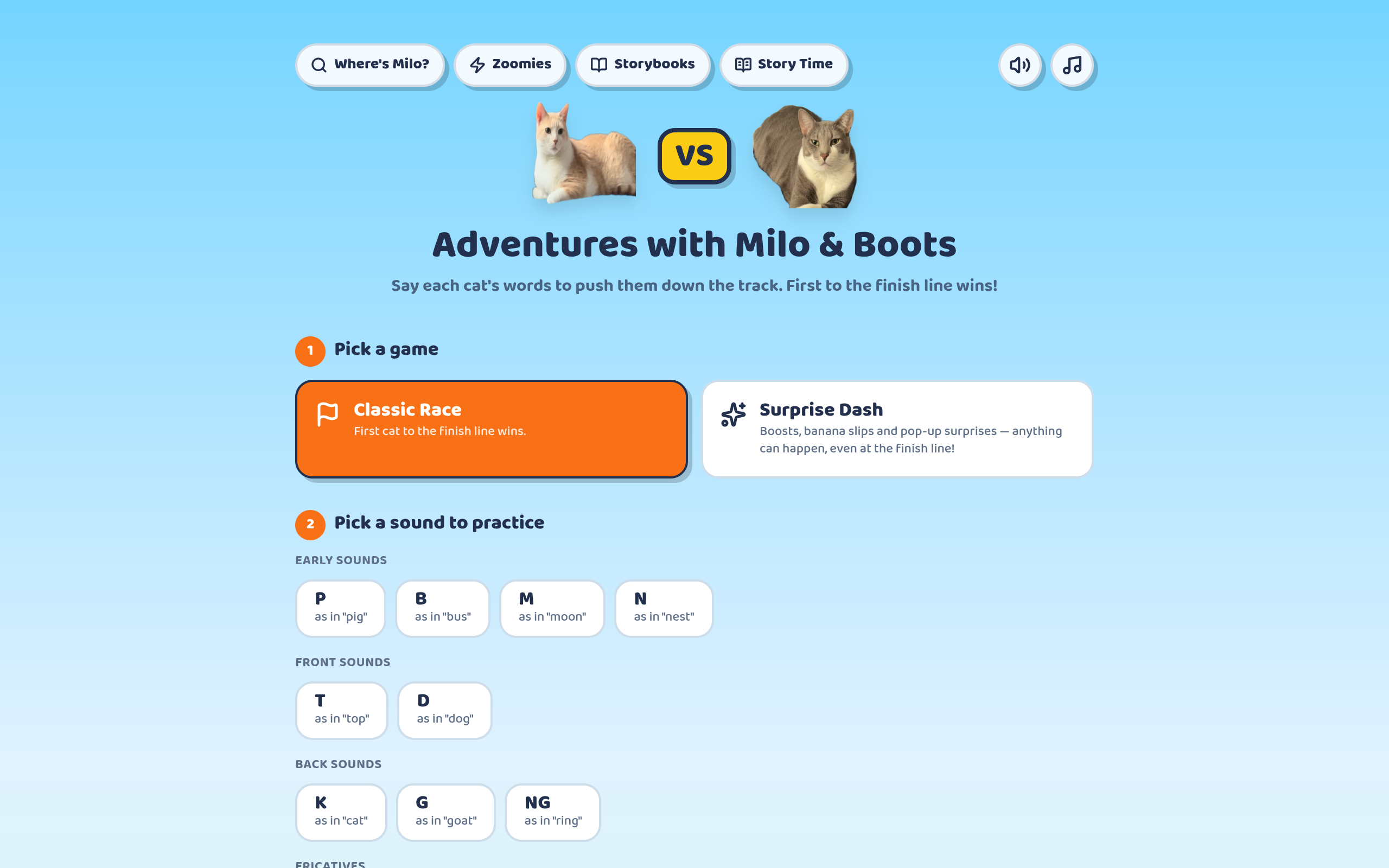
An honest note first: our arcade-style games are not filtered by target sound — they build articulation and speech clarity generally rather than drilling R specifically. The sound-specific targeting lives in the practice tools, where you choose the sound and position, and in the R word lists further down this page.

Where R targeting actually happens

Inside an account, the pronunciation practice and flashcard activities draw from a word bank of 9,400+ words across 23 sounds, and you pick the sound and the position in the word. That is the part of the platform that practises R as R — the games above are what keep a child doing it for long enough to matter.

R practice words

Real practice words, grouped by where the R sound falls in the word. Most therapy starts at the beginning of a word and moves on once that is reliable.

R at the beginning

Words that start with R.

rabbitrainredriceringroadrobotrockroofroom

R in the middle

Words with R in the middle.

aroundberrycarrotcherrygaragegiraffemirrororangeparrotpirate

R at the end

Words with R at the end.

bearcarchairdeerdoorearfarfirefloorfour

What to listen for

The most common substitution is a W — "wabbit" for "rabbit" — but the trickier one is a distorted R that is nearly right. Listen for a muffled, swallowed quality, and remember that vocalic R in words like "bear" and "car" behaves almost like a separate target from the R at the start of a word.

Common R errors

  • Substituting /W/ for /R/ (e.g., "wabbit" for "rabbit")
  • Distorting the /R/ so it sounds mushy or unclear
  • Substituting /L/ for /R/ (e.g., "led" for "red")
  • Omitting the /R/ sound entirely in words
  • Difficulty with vocalic R (ar, er, ir, or, air, ear)

How to run R practice

Short and frequent beats long and occasional. Five to ten minutes on most days produces more correct R productions over a fortnight than one long weekend session, and it is far easier to sustain.

Work in one position at a time. Get R reliable at the beginning of words before moving to the middle and at the end — mixing all three from the start usually slows everything down.

Keep correction light. Model the word correctly and move on rather than asking for a repeat every time; a child who feels tested talks less, and less talking is the opposite of what R practice needs.

Tips for the R sound

  • Practice in front of a mirror so your child can see tongue and lip position.
  • Start with the /R/ sound in isolation before moving to words. Have your child say a prolonged "rrrr" like a growling tiger.
  • Use the "butterfly tongue" cue: ask your child to curl their tongue tip up and back, like a butterfly landing on the roof of their mouth.
  • Practice vocalic R sounds (ar, er, or) separately, as they use slightly different tongue positions.
  • Try the "sliding from /EE/" trick: say "ee" then slowly slide into "er" to feel the tongue move back.
  • Keep practice sessions short (5-10 minutes) and fun. Use games, stickers, or rewards to maintain motivation.
  • Record your child saying words and play them back so they can hear the difference between their production and the target.

Frequently Asked Questions

Are there free games for practising the R sound?
Yes. Every game on this site is free to play with a free account, and the R word lists and sound guide are free to read without one. What the games do not do is filter by target sound — for that, the practice tools inside an account let you pick R and the position in the word.
At what age should a child master the R sound?
Most children master the /R/ sound by age 6-7. It is one of the last sounds to develop and the most commonly misarticulated sound in English. Some children may not fully master all /R/ variations (vocalic R) until age 8. If your child is past that range and the sound has not settled, it is worth asking a speech-language pathologist rather than waiting longer.
What are the most common R errors?
Substituting /W/ for /R/ (e.g., "wabbit" for "rabbit") Distorting the /R/ so it sounds mushy or unclear Substituting /L/ for /R/ (e.g., "led" for "red") Our R sound guide covers each of these in more detail.
Which R words should we start with?
Start at the beginning of words — rabbit, rain, red, rice, ring — and only move to the middle and at the end once the first position is reliable. The full lists are on our R word lists page.
How long does it take to fix a R sound?
It varies far more than most families expect, and depends on the child's age, how established the error is, and how much correct practice happens between sessions. The one factor you control is the volume of correct repetitions per week, which is why practice at home moves the timeline more than anything else.

Start Practising the R Sound

Create a free account and play every game, with the full word bank behind it. No credit card required.

Get Started Free